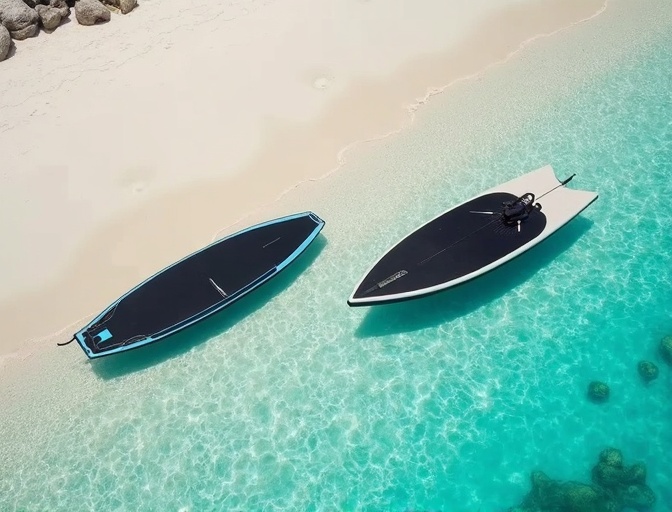
How an eFoil Actually Works
A complete, illustrated explanation of the physics, the engineering and the small acts of magic that allow a 26-kilogram carbon board — with a rider on top — to rise cleanly out of the water and fly in near-silence.
Introduction
The first time you watch an eFoil rise from the water, the instinct is to look for a trick. There is no trick. What you are watching is the same physics that lifts a 350-tonne airliner — Bernoulli's principle, applied to water rather than air — on a wing approximately the size of a serving tray. The whole assembly is propelled by a motor smaller than a kettle and powered by a battery you could carry under one arm. The result, when it works, is one of the quietest forms of motion humans have ever engineered.
This guide explains the four systems that make an eFoil fly — the hydrofoil, the propulsion, the battery, and the control system — and the small but consequential design choices that separate a great board from a merely competent one.
Cruise speed
25–35 km/h
Time to lift off
≈ 4 seconds
Motor power
6–8 kW (peak 12 kW)
Battery
1.5–2.0 kWh lithium-ion
Ride time
60–110 minutes
Noise at cruise
≈ 50 dB (a quiet conversation)
Technical specifications
I · The hydrofoil — the wing that does the lifting
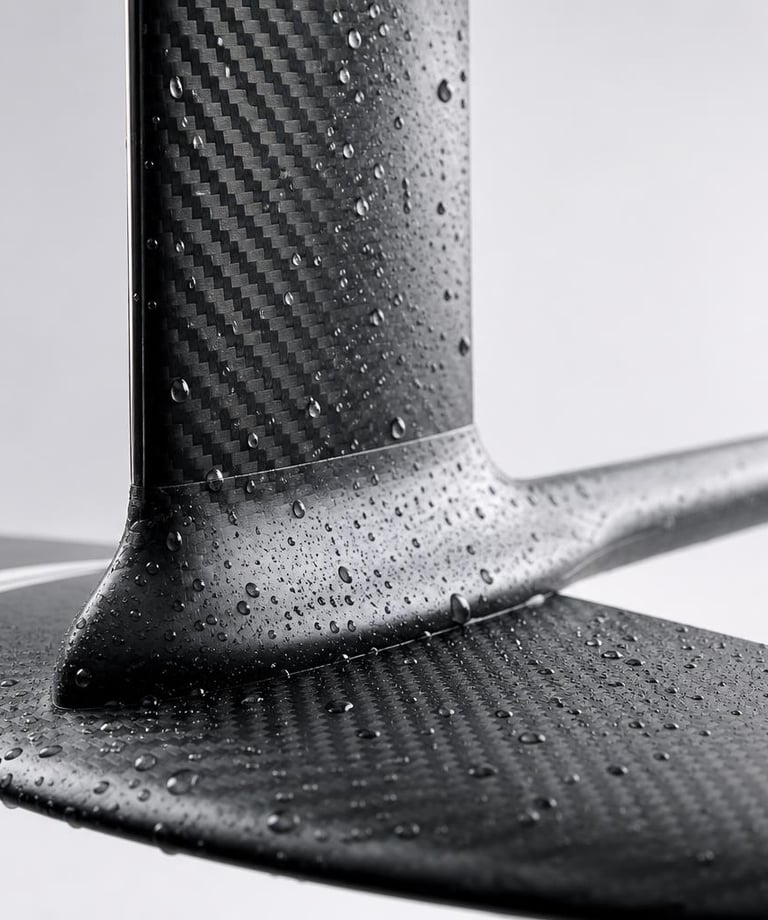
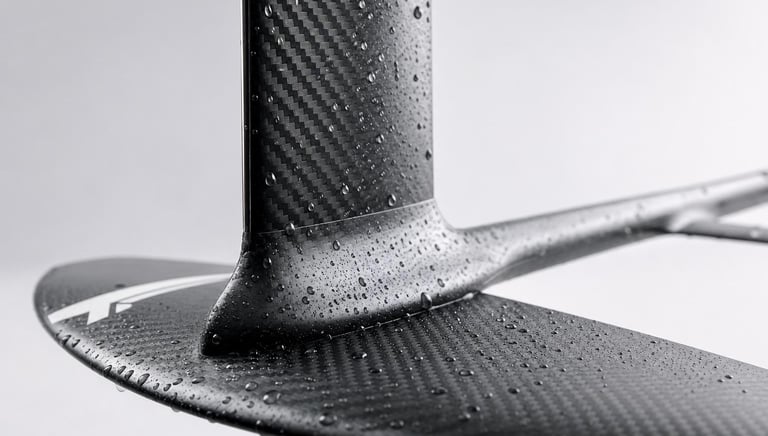
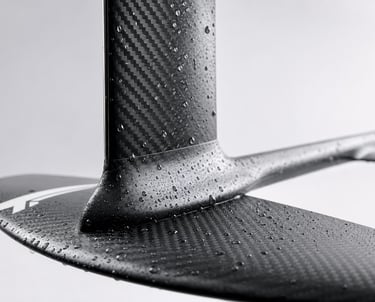
Beneath the board, on the end of a 70 to 90-centimetre carbon mast, sits the hydrofoil. It looks like a small aircraft wing because, functionally, it is one. Its cross-section is asymmetric — flatter on the underside, more curved on the top. As the board moves forward and water flows over the wing, the curved upper surface forces the water to travel a longer distance than the flatter lower surface. By Bernoulli's principle, the faster-moving water above creates lower pressure than the slower-moving water below. The pressure differential generates lift.
Water is roughly eight hundred times denser than air, which is why a hydrofoil wing can be so much smaller than an aircraft wing and still generate enough force to raise a rider clear of the surface. At cruise speed, a wing about the size of a laptop produces ninety to a hundred and twenty kilograms of lift — comfortably enough for an adult rider plus the board itself.
Behind the front wing, on the same fuselage, is a smaller rear wing — the stabiliser. Its job is to keep the assembly trimmed in pitch, in the same way a conventional aircraft's tailplane does. Without it, the front wing would be uncontrollable; with it, the whole package settles into a stable glide.
Why wing choice matters
Riders can swap wings. A larger wing produces more lift at lower speeds — easier take-offs, gentler stalls, ideal for beginners. A smaller wing produces less drag at high speed — sharper carving, higher top speed, the choice of experienced riders. The board does not change. The wing changes everything.
II · The motor — small, brushless, beautifully efficient
A brushless DC electric motor — typically rated at 6 to 8 kilowatts continuous, with peak outputs above 12 kilowatts — is mounted on the fuselage just behind the front wing, driving a small three-bladed propeller. Its only job is to push the board forward. It does not lift. It does not steer. It pushes.
The motor is sealed against saltwater intrusion and cooled passively by the water flowing past it — no pumps, no radiators, no moving parts other than the rotor and the propeller shaft. This is one of the reasons eFoils are so reliable: there is almost nothing to break.
Once the rider reaches roughly 15 km/h, the wing generates enough lift to raise the entire board clear of the water. From that point — the moment of flight — the motor is fighting only the drag of the slim mast and the wing itself. The hull, which represents the vast majority of drag at low speed, is no longer in the water at all. This is why eFoils are so efficient and so quiet at cruise: most of the board is no longer touching anything.
III · The battery — the hardest engineering problem
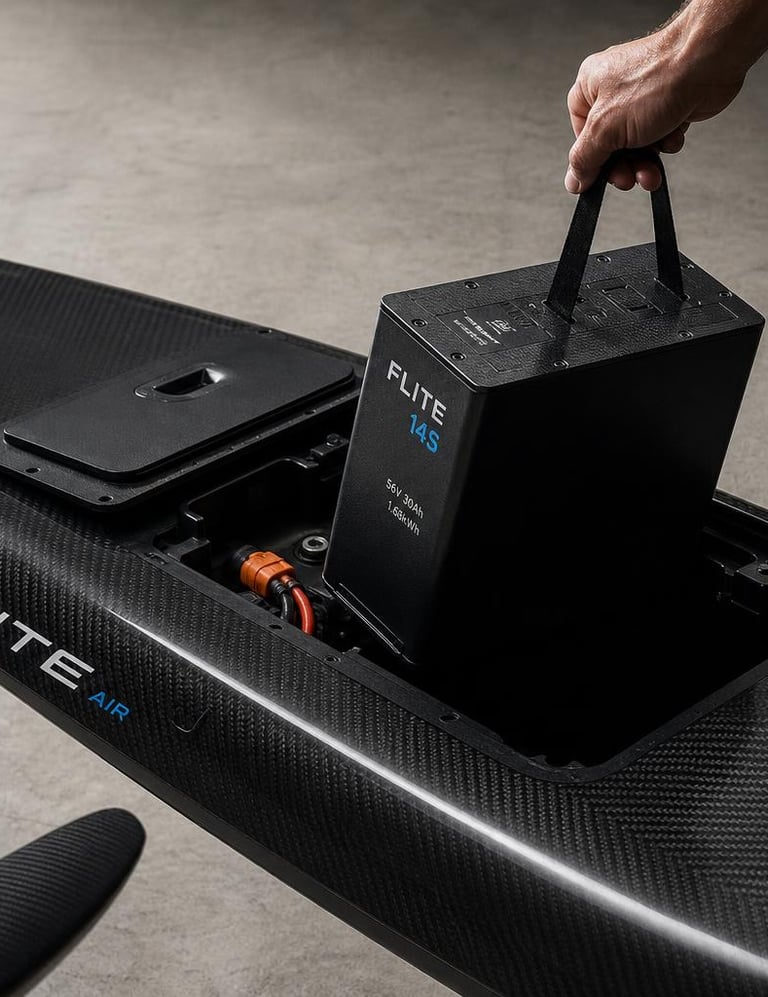
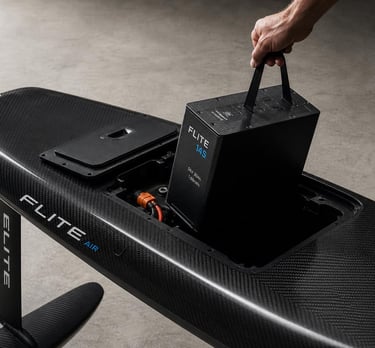
The battery is the part of the system that has progressed most dramatically over the last five years, and the part that still defines the limits of what an eFoil can do. A modern premium pack stores between 1.5 and 2.0 kilowatt-hours of energy in lithium-ion cells, sealed inside an aluminium or composite casing rated for saltwater immersion to several metres.
Energy density matters because every kilogram of battery is a kilogram the wing must lift. The best 2026 packs deliver around 250 watt-hours per kilogram at the cell level — close to the theoretical limit of current lithium chemistry. Future generations will move to silicon-anode and eventually solid-state cells, which promise twenty to forty per cent more energy in the same volume.
The pack is removable, swappable in under a minute, and charges in 90 to 150 minutes from a domestic outlet. Owners who ride seriously carry a second battery — it doubles their time on the water for roughly a quarter of the cost of a second board.
Why batteries cost what they cost
A premium replacement battery costs €2,500–€3,500. The price reflects three things: the cells themselves (expensive), the marine-grade packaging (very expensive), and the certification regime required to ship a 1.8 kWh lithium pack by air or sea (extraordinarily expensive). Cheap third-party batteries exist. They are a fire risk. We do not recommend them under any circumstances.
IV · The control system — your thumb, the leash, and the board's brain
The rider holds a small wireless controller — about the size of a TV remote — in one hand. A thumb-operated trigger commands the motor. A magnetic safety leash attaches the controller to the rider's wrist; if the rider falls, the leash separates and the motor cuts within milliseconds. There is no scenario in which a rider in the water is ever close to a powered propeller.
The controller communicates with the board over a low-power radio link (typically Bluetooth Low Energy or a proprietary 2.4 GHz protocol). Latency is around 20 milliseconds — imperceptible to the rider. Inside the board, a small computer manages throttle response, monitors battery state, controls the cooling logic, and reports telemetry to a smartphone app over a separate wireless channel.
Steering is not done by the controller. Steering is done by the rider's body. Lean forward, the nose drops and the board accelerates downward. Lean back, it climbs. Shift weight to the heels and the board carves left; to the toes, right. The learning curve is in this body language, not in the buttons.
V · How it all comes together — a single ride, narrated
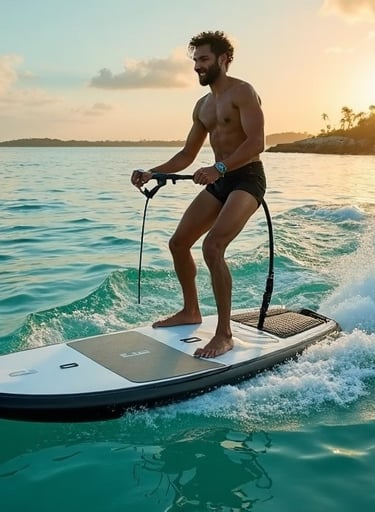
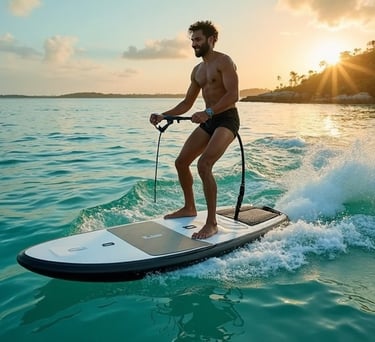
The rider lies flat on the board in calm water, controller in hand. A gentle squeeze of the throttle and the propeller spins up, pushing the board forward. For three or four seconds, the board behaves like a slow surfboard. Then, as speed crosses 15 km/h, the wing beneath the rider begins to generate real lift — and the entire assembly rises smoothly out of the water. The hull breaks contact. The rider, on knees or feet, is now flying.
In flight, the only sound is the soft hiss of water peeling off the trailing edge of the wing. The board feels weightless because, in a real sense, it is — the wing is carrying it, exactly as a wing carries an aircraft. Small shifts in the rider's weight tilt the wing's angle of attack and therefore the altitude of flight. Carving turns are initiated by leaning, exactly as on a snowboard, but with no friction beneath the feet to resist the lean.
The ride ends when the rider eases off the throttle. The board decelerates, the wing loses lift, the hull settles back onto the water, and the rider is once again on a slow surfboard. A skilled rider can repeat this take-off and landing cycle dozens of times in a single battery.
What an eFoil is not
In its favour
An aircraft principle applied to water — efficient and quiet by design
A genuinely zero-emission, zero-wake form of motion
Mechanically simple — almost nothing to maintain
A surprisingly safe sport: no exposed propeller, instant motor cut-off
Worth noting
Not a jet ski — it is slower, quieter and carries one rider only
Not a surfboard — there is a motor and a battery worth more than a car
Not a substitute for swimming ability — riders must be confident in deep water
Not maintenance-free — saltwater rinsing after every ride is essential
How fast can an eFoil go?
Premium production boards top out between 40 and 50 km/h. Most riders cruise comfortably at 25–35 km/h. The sensation of speed in flight is significantly greater than the number suggests, because the board is so close to the water and so quiet.
How long does the battery last?
Sixty to one hundred and ten minutes per charge, depending on the board, the rider's weight, and how aggressively they ride. Cruising gently extends ride time substantially; constant high-speed carving cuts it in half.
Is the motor dangerous?
The propeller is shrouded by the fuselage and the rear wing, and the magnetic safety leash cuts power within milliseconds of being dropped. eFoils have an excellent safety record — significantly better than jet skis on a per-hour basis.
Can it work in the ocean?
Yes — the entire system is designed for saltwater. Owners must rinse the board with fresh water after every ride and inspect the seals annually, but the boards are built for the marine environment.
How long do eFoils last?
A well-maintained premium eFoil should last seven to ten years. The battery is typically the first major service item, with replacement recommended after about 500 charge cycles.
The deeper truth
An eFoil is, in the end, a triumph of subtraction. Strip a powerboat of its hull drag, its engine noise, its fuel weight and its wake — and what remains is this board: silent, efficient, and, when it lifts you out of the water for the first time, genuinely magical. The technology is not new. Hydrofoils have existed for over a century, electric motors longer still. What is new is the combination, the battery density, and the design discipline that makes the whole thing weigh less than thirty kilograms. That combination is why 2026 is the year flight on water finally went mainstream.